

For an Australian small business, a disruption rarely arrives as one neat technical event. It may start with a staff member unable to reach a line-of-business system, a failed internet connection, a deleted folder, a compromised account, a server problem or a supplier outage. The immediate question is not simply whether a backup exists. It is whether the business knows what must keep operating, who can make decisions, which systems come first and how the team will restore work without creating more confusion.
That is the value of business continuity. It gives business owners a repeatable way to protect critical work before an interruption puts every decision under pressure. A sensible continuity plan combines people, processes, suppliers, communications, systems and recovery arrangements. It is broader than disaster recovery and broader again than a scheduled backup job. The goal is practical: keep essential functions moving, or bring them back in the order the business actually needs.
The 3-2-1 backup rule is an important part of that discipline. It helps reduce the risk that one failure, one location or one compromised storage system takes every recovery copy with it. But it works best when it is linked to business priorities, protected access and a tested process for getting back to usable operations. This guide explains how an Australian SME can turn the rule into an everyday continuity habit.
Business continuity is the operating plan, not only the backup
A business continuity plan considers how critical business functions can be maintained or re-established during a disruption. That wording matters because the plan needs to work beyond the technology team. It should tell the business what happens when staff cannot access systems, a key supplier is unavailable, a building is closed or a cyber incident changes normal working conditions.
Start by identifying the outcomes that cannot wait. A professional-services firm may need email, documents, phones, customer records and remote access. A trade business may need job schedules, supplier contacts, quoting tools, payroll and a way to notify customers. A retailer may need payments, stock information, ecommerce and a manual process for taking orders. The same outage can have a very different consequence depending on the work the business has committed to deliver that day.
That is why an owner should avoid treating a continuity plan as a long document that is filed away after a workshop. The useful version is a working decision guide. It clarifies who can declare an incident, who speaks to staff and customers, which providers must be contacted, where the current procedures are stored and which workarounds are acceptable for a limited period. If the first hour of an interruption is unstructured, even capable people can duplicate effort or make decisions without the information they need.
Where the 3-2-1 backup rule fits
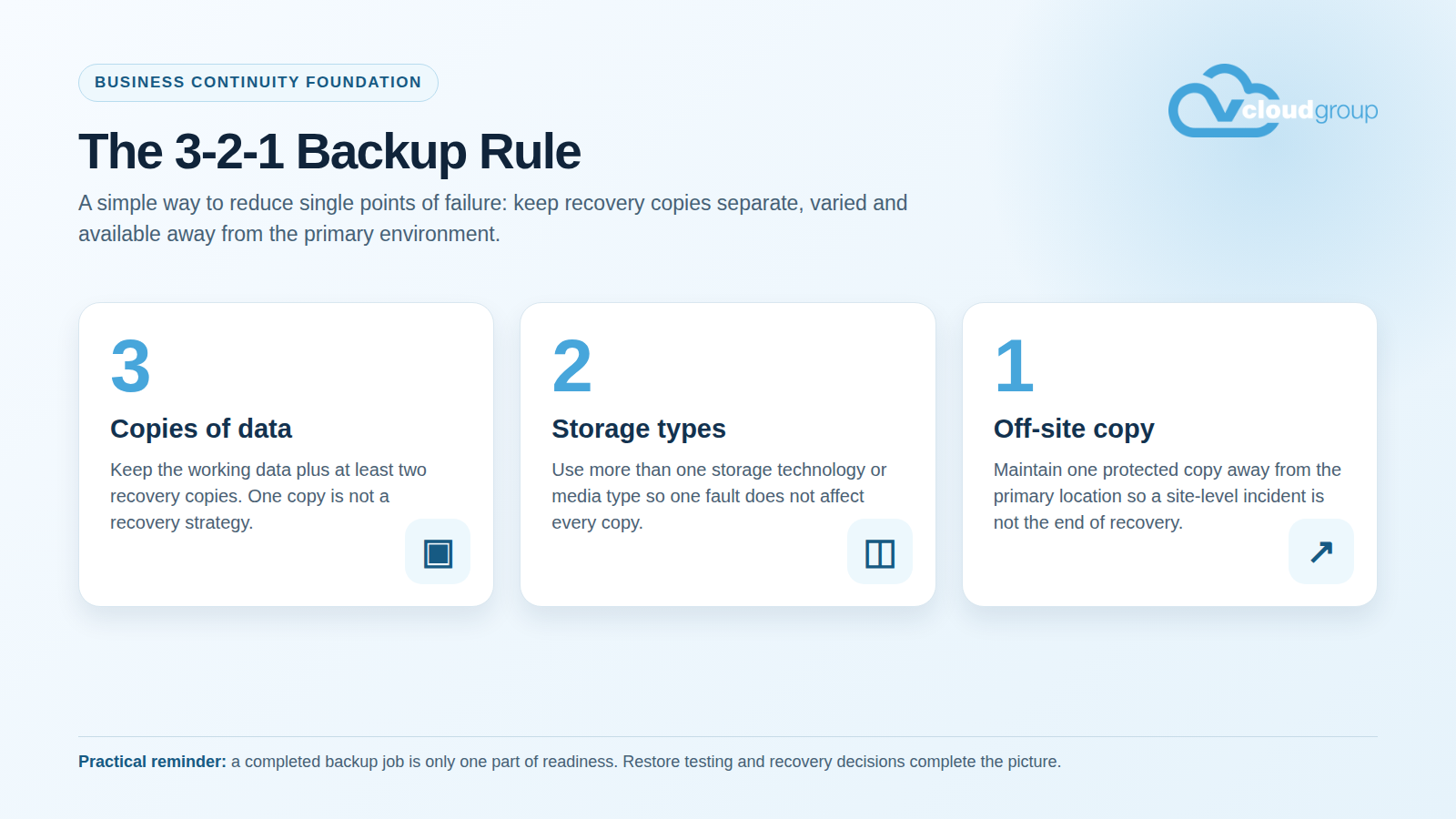
The 3-2-1 rule provides a straightforward recovery foundation: keep three copies of data, on two different storage media types, with one copy held off-site. It is intentionally simple, but the questions it prompts are valuable. Where are the copies? Are they genuinely independent? What happens if the primary office, server, cloud tenant or administrator account is affected?
Three copies means more than saving the same file twice in the same place. It generally includes the live working version and at least two recovery copies. The separation is important because a deleted file, synchronisation error, hardware fault or compromised account can otherwise be repeated across every location.
Two storage types does not mean a business needs to collect technology for its own sake. It means considering whether every copy depends on the same failure mode. The right combination will depend on the systems, data volume, recovery targets, supplier arrangements and the way staff work.
One off-site copy protects against events that affect a whole location or primary environment. “Off-site” should be interpreted practically: the copy needs to remain available when the systems and location that hold the primary data are not.

The rule is a framework, not a promise that every business will recover automatically. For example, a protected copy may still be unusable if there is no documented access, the restore account is unavailable, the required software licence cannot be reached or the recovered data has not been checked. Use the rule to ask better questions about independence and access, then document the answers in the continuity plan.
Why a successful backup email is not recovery evidence
A completed backup report tells you that a process ran. It does not, by itself, prove the business can find the right data, restore it within an acceptable timeframe, reconnect the required application or resume the work that matters. Recovery testing gives the business evidence instead of assumption. Practical backup guidance recommends scheduled recovery tests and aligning them with recovery time and recovery point objectives.

A useful test starts with a realistic scenario. It might be recovering a specific customer folder, bringing back a key virtual machine, accessing a cloud service through an alternate method or confirming that named people can retrieve the current continuity plan.
Keep the scope controlled. The purpose is not to create unnecessary disruption; it is to observe the steps, permissions, timing, dependencies and decisions that real recovery would require. Record where the process was smooth and where a person, system or supplier created a delay.
Include the people who actually perform the work. Business-continuity guidance encourages staff involvement and simulations because they can uncover practical gaps that a document alone does not reveal.
Testing should update the plan, not produce a report that is ignored. If a restore takes longer than expected, record why. If a provider escalation path is unclear, correct it. If staff need a different fallback process, make the decision while there is time to explain it. The stronger result is a more usable recovery process, not a pass/fail badge.
Set recovery priorities before disruption chooses them for you
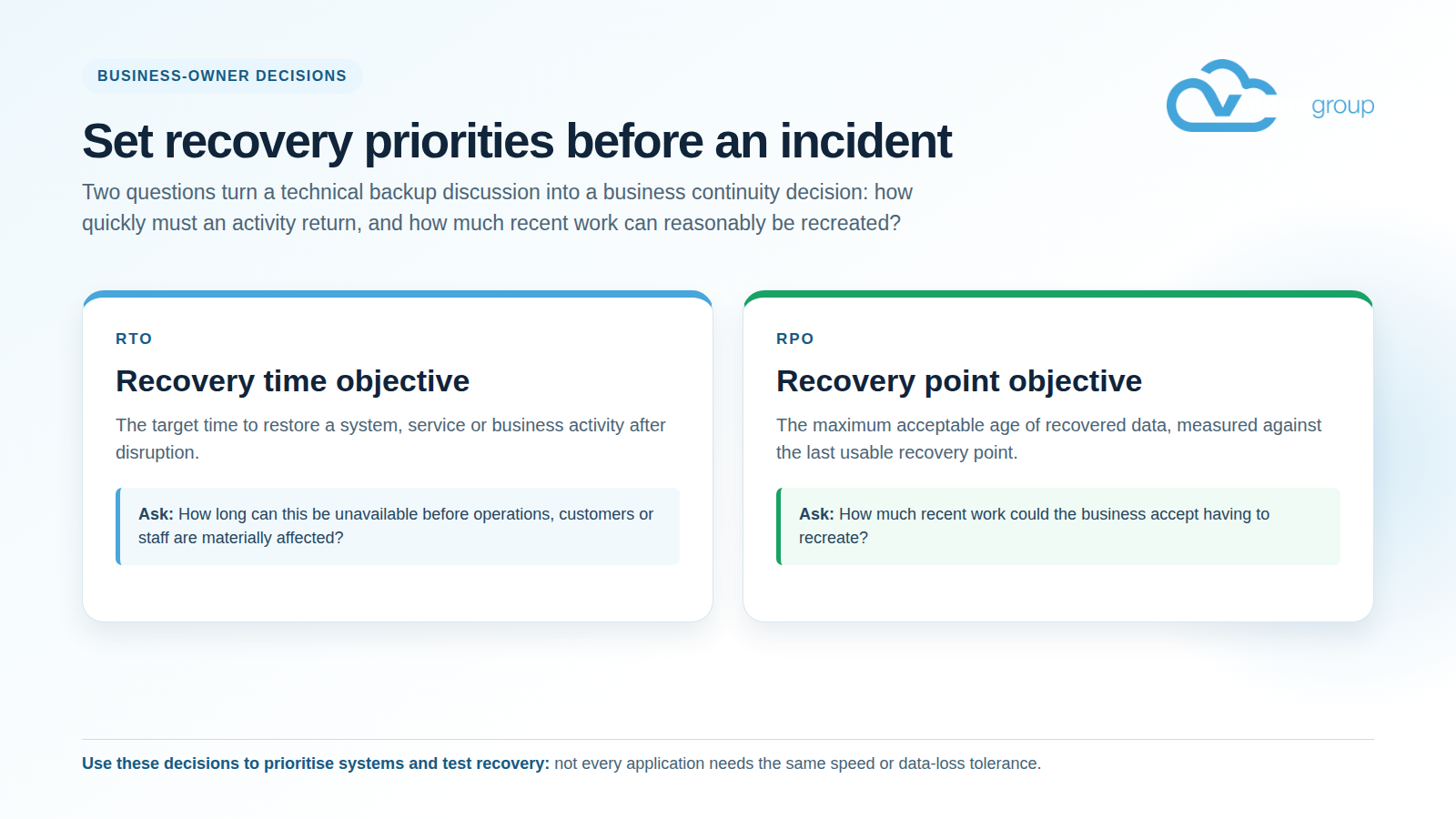
Every system is not equally urgent. A continuity conversation becomes much more useful when the owner can describe two things: how long a service can be unavailable before business impact becomes unacceptable, and how much recent data or work the business can reasonably recreate. These are commonly expressed as recovery time objective (RTO) and recovery point objective (RPO).
RTO is about time to restore a service or activity. RPO is about the acceptable age of the recovered information. They are decisions for the business, informed by technology, contracts, staff workflow and customer commitments. A scheduling system may need a much shorter restoration target than an archive. Payroll may have a different data-loss tolerance from a marketing drive. Naming those differences in advance prevents every system from competing for attention when an interruption happens.
Those decisions also make supplier conversations clearer. Rather than asking a provider for “better backups”, the business can ask how a defined system is protected, what recovery sequence is planned, what access is needed and what is tested. That does not require every business owner to become an infrastructure specialist. It requires the owner to set priorities, approve trade-offs and expect the plan to be understandable.
Use a quarterly review to keep the plan current
A continuity plan should change when the business changes. New staff, a new accounting platform, a move to Microsoft 365, a changed supplier, remote work, an office relocation, an acquisition or a new customer commitment can all alter what “recovery” needs to look like. For many SMEs, a quarterly review is a sensible operating rhythm because it creates a regular point to compare the document with the real business.
This is a recommendation, not a claim that every organisation has the same mandatory timetable. A stable business may carry out a short review; a business changing systems, suppliers or operating locations may need a more detailed check sooner. The important principle is to avoid waiting for an outage, renewal or crisis before discovering that names, contacts, priorities or recovery instructions are out of date.
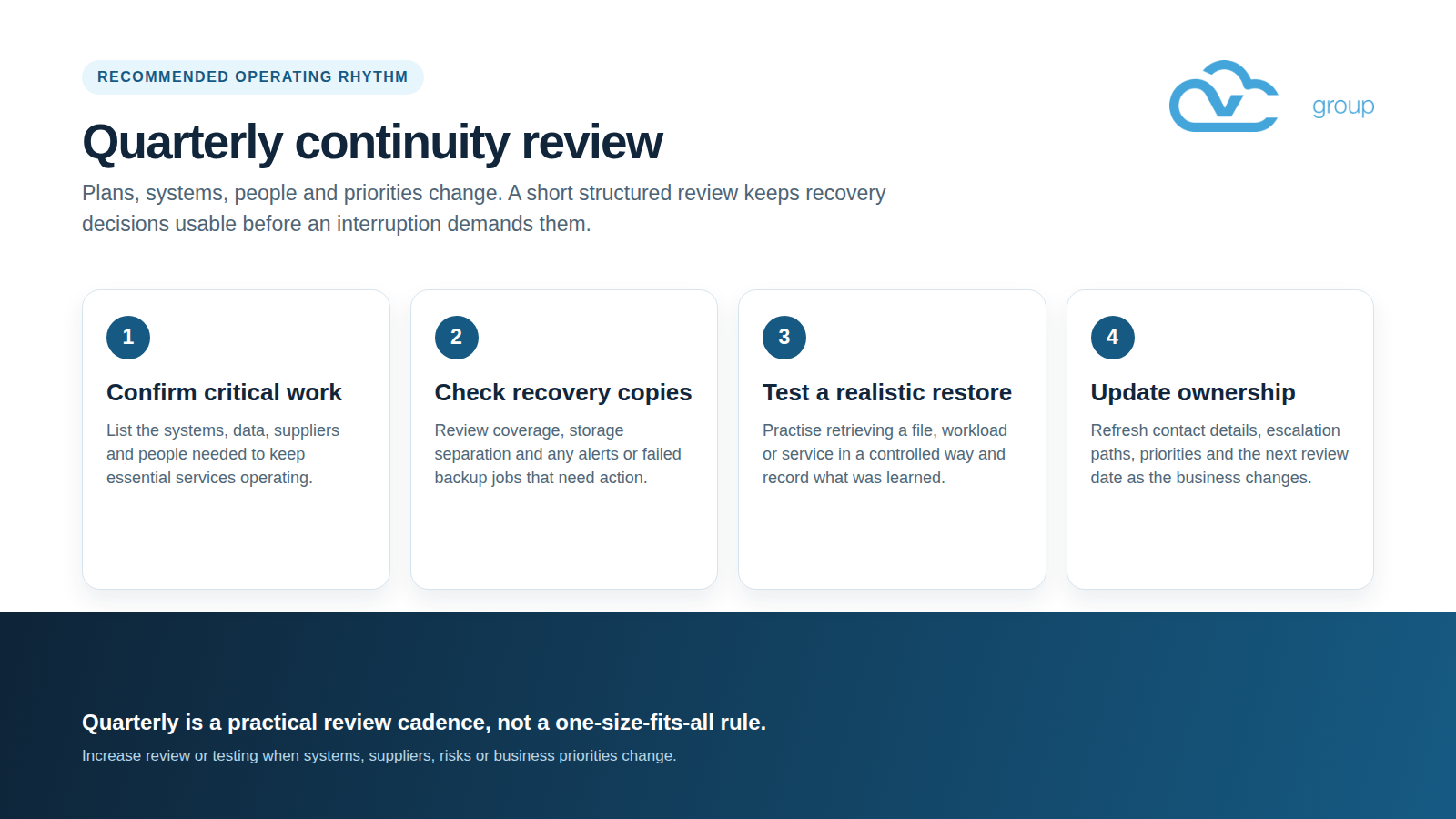
A practical quarterly agenda can be short. Confirm the critical systems and the order they would be restored. Check that backup coverage and off-site separation remain appropriate. Test one realistic recovery action. Review the people, provider contacts and escalation paths. Then record what changed and what needs follow-up. This creates a trail of decisions that is useful to the owner, the team and any provider supporting the environment.
Maintaining that review rhythm also reinforces accountability across internal leaders and external service partners. When an IT provider or managed hosting specialist knows that recovery configurations, retention windows and administrative permissions are reviewed every ninety days, assumptions are replaced with documented status. Business leadership gains a reliable record of what has been tested, what risks have been accepted, and which operational improvements are scheduled for the following quarter.
Questions to answer before the next review
A productive review is not a technology shopping list. It is a chance to make a small set of business decisions visible and testable. Owners do not need to know every implementation detail, but they do need clear answers that can be checked with the people and providers responsible for the environment.
- Which work must continue first? Name the activities that keep customers informed, staff productive, money moving and commitments on track. Put them in a recovery order rather than assuming every system has equal urgency.
- Who can access the plan and the recovery accounts? Document the right business owners, internal contacts and provider roles. Avoid a situation where all knowledge or administrative access rests with one unavailable person.
- Where are the recovery copies and how would you reach them? Confirm the location, the storage separation, the required permissions and the steps needed to retrieve a representative item without relying on memory.
- What did the last test teach the business? Record the timing, dependencies, decision points and blockers. A finding is useful when it changes the next test, clarifies an owner or improves the written procedure.
These questions also make it easier to have a focused conversation with a managed IT provider. They establish the business outcome first, then allow the technology design, backup retention, access controls and supplier responsibilities to be checked against that outcome. The result should be a plan that business leaders can understand and staff can follow when the normal way of working is unavailable.
Build a plan that staff can actually use
Business continuity should make an interruption more manageable, not create a second problem in the form of a complicated document. Keep the instructions clear enough that the people responsible for the first actions can use them under pressure. That may include a current contact list, the location of recovery credentials, a decision tree for who communicates with customers, priority systems, manual workarounds and criteria for escalating an incident.
It is also important to connect continuity with cybersecurity. A backup strategy does not remove the need for secure administration, multi-factor authentication, malware protection or sensible access management. Those controls help reduce the chance and impact of an incident; continuity gives the business a structured way to respond when something still goes wrong. For a related view of layered access and malware controls, see the vCloud Group guide to cybersecurity defences and recovery readiness.
For organisations reviewing their broader digital infrastructure, connecting continuity planning with core hosting and IT operational safeguards ensures that domain registration, tenant administration, mailbox archiving and server backups are not managed in separate silos. Aligning those layers under verified business ownership gives Australian organisations confidence that an outage, hardware retirement or provider transition will not stall day-to-day operations.
vCloud Group’s Business Continuity+ service information describes a planning approach that considers business interruption processes, systems and scenario testing. The right scope will vary by business. What matters is that the plan, recovery copies and responsibilities are visible to the people who must use them.
Start with your continuity priorities
If you want to compare your critical systems, recovery priorities and current backup arrangements, the vCloud Group discovery questionnaire is a structured starting point. It opens a conversation; it does not automatically book or deliver a continuity plan.