

As Australian businesses explore new productivity opportunities across their managed IT and cloud platforms, artificial intelligence is quickly moving from experiment to daily workflow. To support safe technology adoption alongside our wider knowledge hub and security guidance, Artificial intelligence can help a business move faster, reduce repetitive work and explore better ways of serving customers. But the strongest result does not come from giving everyone the same tool and hoping productivity follows. It comes from a deliberate business strategy: choose a useful problem, decide who owns the outcome, set clear boundaries for people and data, and test the change before scaling it. This guide gives Australian business owners a practical way to make those decisions.
AI strategy is a business decision before it is a technology decision
It is easy to begin with the question, “Which AI tool should we buy?” That question is usually too early. A better starting point is to identify a business friction that is specific enough to improve: slow first drafts for recurring proposals, fragmented meeting notes, a repetitive internal workflow, difficult knowledge retrieval, or a customer enquiry process that needs more consistent triage. The goal is not to make every task “AI-powered”. It is to decide where assistance could improve a process without reducing quality, trust or accountability.
Australian small-business guidance recognises that AI tools can assist with productivity, automation and customer experience, while also introducing risks around data leakage, unreliable outputs and third-party dependencies. That combination is why business strategy matters. The owner or leadership team needs to decide what outcome matters, what information may be involved, how a result will be checked and when a pilot should stop. A tool can support the decision; it should not become the decision maker by default.
For a small or medium business, the first AI project does not need to be large. It needs to be understandable. If the team cannot explain the starting problem, the person responsible, the data boundary and the success evidence in plain language, the scope is probably not ready for broad rollout.
Start with one outcome, one owner and a controlled pilot
Choose a practical use case that a business owner can observe. “Help the service team prepare a first draft of common answers” is more useful than “use AI for customer support”. “Summarise approved internal meeting notes for the project lead to review” is more useful than “automate administration”. The narrower statement makes it possible to define the source information, the approval step and the boundaries of the test.
Then assign a business owner, not only a technical contact. That person should be able to explain why the use case exists, who may use it, what needs review and what would cause the pilot to be paused. Technical support remains important, but strategy requires an accountable business decision about the workflow and its impact.
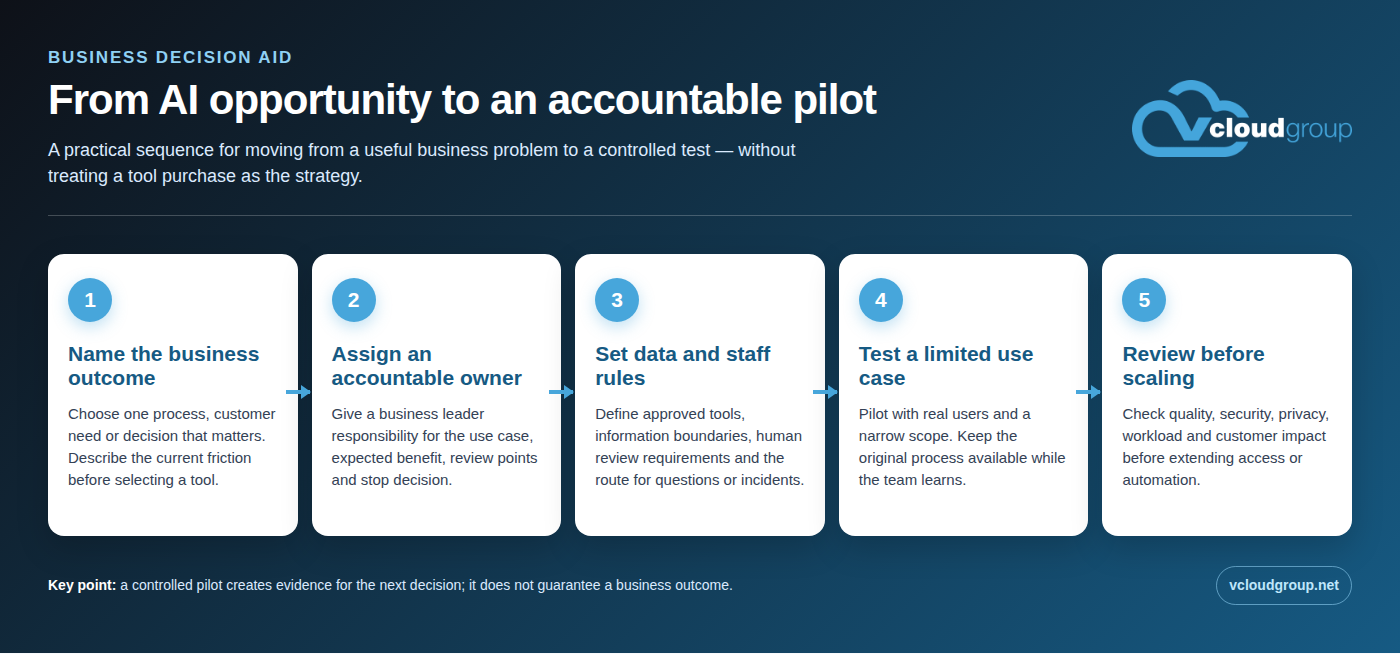
A short pilot should preserve the existing process while the team learns. Compare the assisted result with the previous way of working. Ask whether the work became clearer, faster or more consistent; whether users understood the limits; and whether any customer, privacy, security or quality concern appeared. A controlled pilot creates evidence for a next decision. It does not promise a guaranteed saving, result or long-term fit.
This staged approach aligns with a broader risk-management mindset: governance should be part of selecting, using and evaluating AI, rather than being added after the business has already made the tool broadly available.
Give staff a usable AI rulebook, not a vague warning
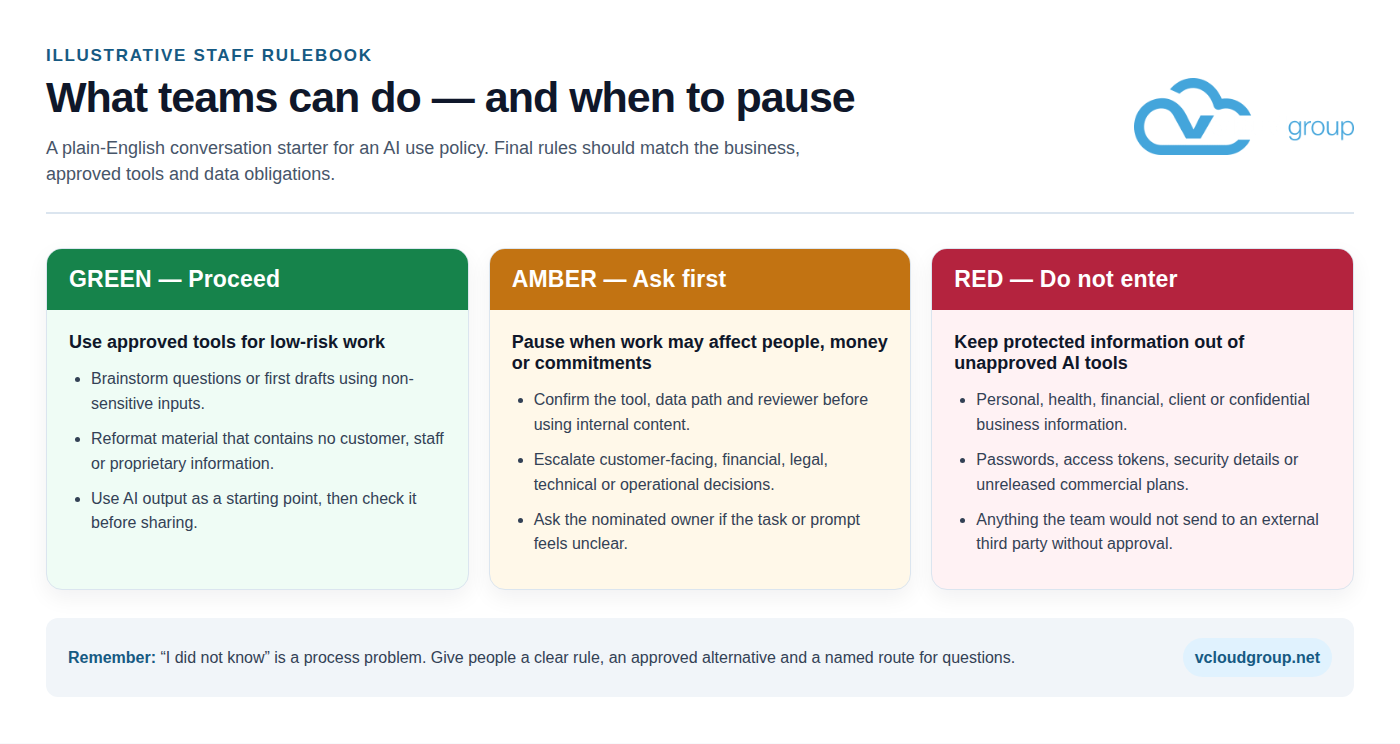
Most staff want to solve a problem quickly, not create a risk. That is why “be careful with AI” is not an operating model. A useful policy names the approved tools, the kinds of work they may support, the information that must never be entered and the point at which a person needs to ask before continuing.
The practical distinction is simple: low-risk, non-sensitive drafting may be acceptable in an approved environment; work involving confidential records, customer information, financial decisions, security detail or a public commitment needs a defined review or an alternative process. Staff should know who answers the question when a task falls between those two categories.
The Australian Government’s essential AI practice is direct: an organisation using AI should have a clear policy that explains how it can be used, who is responsible and the rules people need to follow. In practice, that policy works best when it is translated into examples relevant to the team’s work rather than left as a document no one can apply under time pressure.
“I did not know I should not do that” is often a sign that the business has not provided an approved alternative, a clear escalation route or training that fits the actual tools people use. Treat it as a process and leadership issue first. The response should clarify the rule, improve the workflow and review whether the technology settings support the written expectation.
Protect information before it reaches the prompt
Data handling is one of the most important strategic decisions in AI adoption. A prompt can contain more information than the person writing it realises: a customer name, a staff concern, a project detail, source code, a pricing position, a copied meeting transcript or an attachment that reveals sensitive context. The safe question is not simply whether an AI answer is useful. It is whether the business is authorised and prepared to provide that information to that specific environment.
The Office of the Australian Information Commissioner advises regulated entities to refrain from entering personal information, especially sensitive information, into publicly available tools. It also highlights the need to manage privacy settings, develop policies and procedures, equip staff to check inaccuracies, and communicate responsible-use expectations. This does not mean every business must reject AI. It means that the business needs to distinguish public tools, approved organisational tools and information that should remain outside the AI workflow altogether.
Build the rule around the information, not the excitement around the tool.
- Classify the kinds of information the business handles: public, internal, confidential, personal, financial, health, security or commercially sensitive.
- Confirm which approved tools may receive each category and which settings, accounts or contractual terms matter.
- Provide a safe route for staff to remove identifying details, use an approved alternative or ask for help when the boundary is unclear.
Vendor review belongs in the strategy too. Before a broader rollout, understand the provider’s data-handling approach, privacy and security controls, retention position, access model, incident path and the role of any connected third-party service. The answer may differ between a free consumer account, an enterprise plan or an AI feature already embedded in a business platform. Do not assume two tools have the same settings or that a logo on a website answers the data question.
Keep a human responsible for significant outcomes
AI output can sound assured even when it is incomplete, outdated, biased, based on the wrong context or simply incorrect. It can also be influenced by malicious or irrelevant input where an AI system interacts with documents, websites or customer messages. The more an output affects a customer, a price, a contract, a security decision, a public statement or an important operational choice, the stronger the human review should be.
Human review is not a ceremonial click on an “approve” button. The reviewer needs the authority and enough context to test the answer against the source material, check for missing nuance and decide whether the output should be edited, rejected or escalated. The person remains accountable for the business action taken from the result.
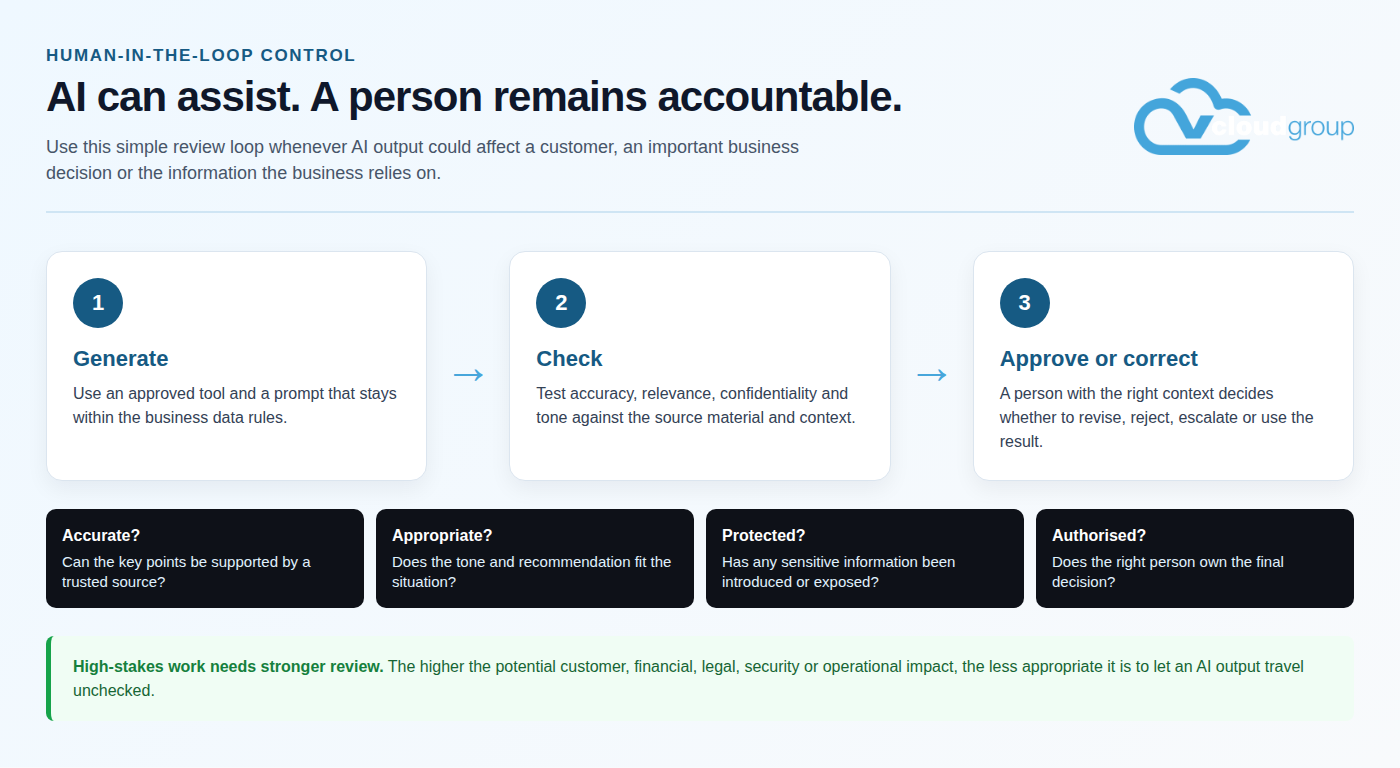
Australian small-business cyber guidance specifically recommends verifying AI-generated output and maintaining human oversight for important business decisions. Build that expectation into training, checklists and workflow ownership from the beginning. A good AI process should make it easy to see who reviewed a high-impact result, what source they used and what they decided.
This principle also protects staff. A team member should not be left carrying the responsibility for a high-stakes AI-assisted recommendation without a clear reviewer, a documented process and permission to stop when the output does not look right.
Choose tools after the controls and workflow are clear
Once the business knows the outcome, information boundary, owner and review step, it can compare tools more intelligently. The best option may be an existing feature inside a platform the team already uses, a managed enterprise AI service, a purpose-built workflow or no new tool at all. The selection should follow the use case rather than a general fear of missing out.
Ask practical questions: What data will enter the tool? Which people need access? Can permission levels be limited? What happens if the provider changes a feature or experiences an incident? Can the business explain the output to a customer or auditor if needed? What is the cost of a mistake? Where will users go when the tool cannot answer? These are strategy questions because they determine the operational model, not just the software licence.
A useful tool evaluation includes the people who own the work, the technical team that understands the environment, and a decision maker who can balance value against risk. That group should agree on the first permitted use, prohibited inputs, success criteria, escalation route and review cadence before staff are asked to change the way they work.
Test, learn and scale with evidence

Start with a limited group of trained users, a narrow workflow and an agreed end date for review. Keep a simple record of what the pilot is meant to improve and what the team observed. That can include the quality of first drafts, the time required for the whole task, exceptions, staff feedback, customer impact and any near miss involving data or accuracy.
Scaling should be a conscious decision. If the pilot creates confusion, inaccurate work or unclear data handling, pause and improve the process before adding more users. If it shows a genuine benefit, extend access in stages and keep the owner, policy and review checkpoints in place.
Training should evolve with the rollout. Show staff the approved tool, what it is good for, what it is not for, examples of safe and unsafe inputs, the required review steps and where to report a concern. Revisit the guidance when the business adopts a new tool, connects another data source or expands the scope of automation. A one-off launch session is rarely enough for a change that affects everyday work.
For advice on shaping a use case, choosing a practical direction or developing an AI-based solution, vCloud Group’s AI partner AI by Design offers a starting point for a business conversation about what to build and how it should fit the workflow. The aim is not to force an AI project into every process. It is to make sure that a useful idea becomes a solution the business understands, owns and can operate responsibly.
Five executive questions before expanding AI use
Before moving from experimentation to broader use, leadership should be able to answer five questions. First, what specific business problem is the AI use case solving? Second, who owns the outcome and the decision to continue, change or stop it? Third, which information can enter the approved tool, and which information must remain out? Fourth, who checks important outputs before the business acts on them? Fifth, how will the team know whether the change is improving the process without introducing a larger customer, privacy, security or operational concern?
Those questions make AI business strategy practical. They prevent a business from mistaking access for readiness, while still leaving room to use AI where it can genuinely help. Start small, set the guardrails, keep people accountable and build evidence before scaling. That is a more durable approach than either banning every new tool or adopting one without a plan.
Key Takeaways for AI Business Strategy
- Start with a defined business outcome and an accountable owner before selecting an AI tool.
- Give staff clear approved-tool, data-boundary and escalation rules so they know when to proceed and when to pause.
- Keep personal, confidential and commercially sensitive information out of unapproved AI environments.
- Require meaningful human review for outputs that affect customers, finances, security, operations or important decisions.
- Use a controlled pilot and evidence-based review before expanding access or automation.