

Hand-balling IT support happens when an issue crosses providers and the customer is left to repeat the problem, relay updates and decide who should act next. A business can keep specialist providers where they add value. The practical safeguard is to agree on one accountable coordination path for the overall environment, including configuration, maintenance, incident communication and escalation.
What “hand-balling” IT support really means
Most businesses do not set out to create a complicated IT environment. A cloud platform may be supplied by one company, internet connectivity by another, phones by a specialist, business software by a vendor, and day-to-day support by an MSP. Each supplier can be capable in its own area. The trouble begins when a single staff problem touches more than one of those areas.
Someone cannot access a cloud application. Is the problem the internet circuit, the identity service, the hosted desktop, the device, a phone-system setting or the application itself? If every party answers only for its narrow component, the business owner or office manager can end up being asked to open several tickets, repeat the same history and carry messages from one technical team to another. That is the practical experience behind hand-balling IT support.
It is not the same as an outside specialist being involved. A carrier, software vendor, hardware warranty provider or cybersecurity partner may still need to investigate. The real question is whether one party stays accountable for the customer-facing coordination while that work happens. Roles, responsibilities and the escalation process should be explicit when an issue crosses provider boundaries.
Multiple providers are not automatically the problem
A business may have good reasons to retain multiple providers. An existing line-of-business platform may require a specialist. A connectivity carrier may own the circuit. A cloud application may be chosen for its particular capability. Some businesses also prefer commercial choice rather than forcing every technical function into one contract. None of that automatically means the setup is wrong.
What needs to be designed is the integration layer. Service Integration and Management, often shortened to SIAM, is one industry term for coordinating multiple suppliers through a business-facing management function. A separate integrator, a lead supplier or a retained internal team can coordinate suppliers, but clear service definitions, governance, hand-offs and collaboration still matter.
For a small or medium business, that does not need to become a complicated enterprise programme. It can be a clear operating agreement: one named lead, an up-to-date service inventory, a simple responsibility matrix and a documented route for escalating issues. The point is not to push other providers out. It is to ensure the customer is not the default service integrator.
When the customer becomes the middle person
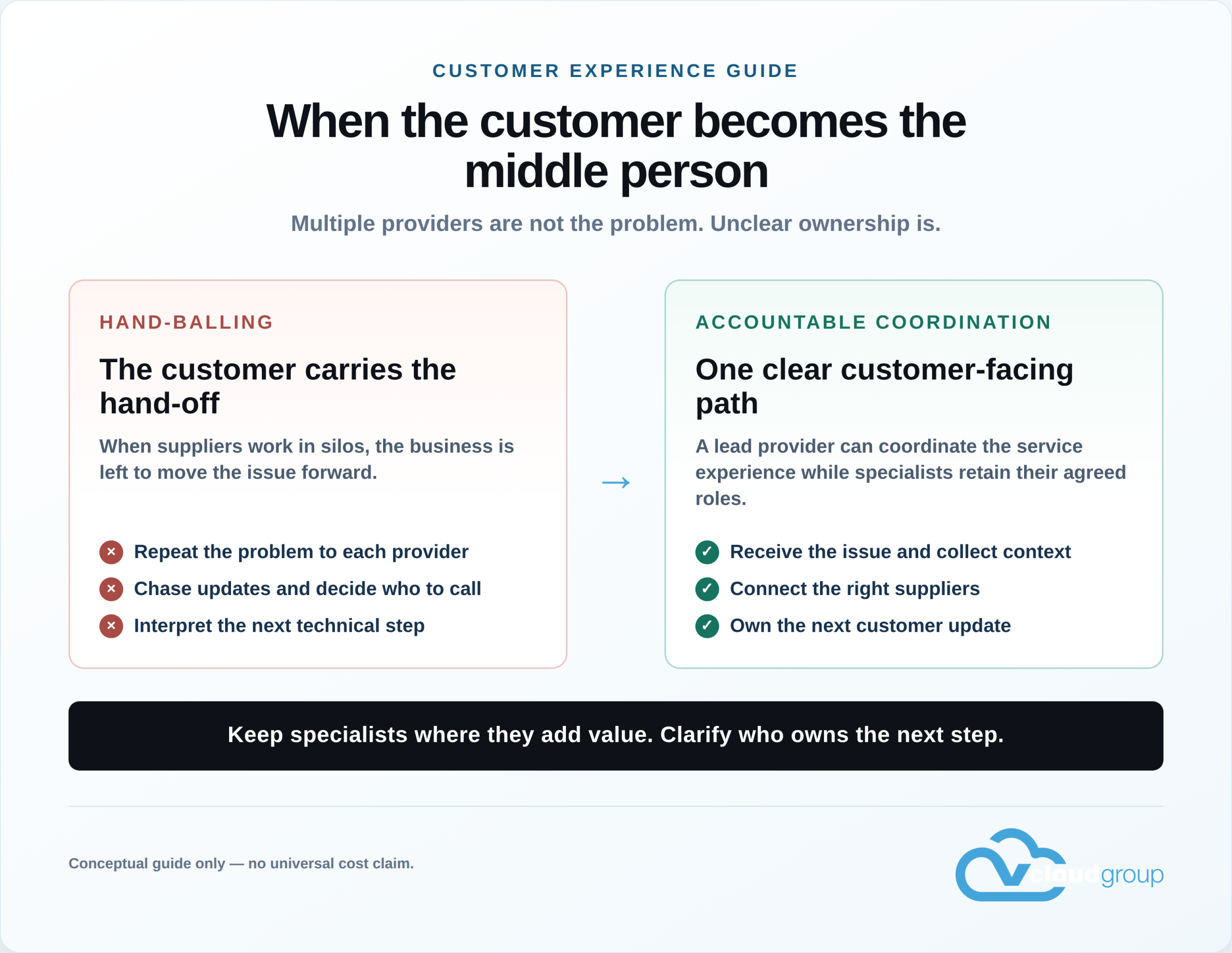
Being the middle person is costly in a very practical sense. A staff member loses time describing the issue several times. A manager has to decide which supplier to call. Important details can be lost between tickets. Change windows may be delayed because one party is waiting for another. The customer may also be asked to decide whether an activity is in scope before the technical teams have jointly established what happened.
The headline of this article retains the established wording about “thousands”, but the actual cost will vary by organisation, interruption and contract. This article does not claim a universal dollar figure. The more defensible point is that repeated disruption, duplicated conversations, delayed decisions and unowned hand-offs consume staff time and attention that should be spent running the business.
Multi-vendor arrangements can work, but they need active coordination. Provider relationships can become more complicated when information, responsibility or a required hand-off is disputed. That is a reason to define the operating model in advance, not a reason to assume every specialist supplier should be replaced.
At vCloud, no hand-balling means accountable coordination
At vCloud, the phrase no hand-balling IT support should be understood as an operating principle, not as a promise that one team personally owns every third-party platform. Where vCloud has the agreed scope, access and authority, the role is to accept the issue, establish the likely dependency, coordinate the right supplier, keep the customer informed and remain responsible for the next customer-facing update until the matter is resolved or clearly transferred under the agreement.
That approach is consistent with vCloud Group’s focus on integrating cloud platforms into a single working environment rather than treating cloud services as disconnected products. The vCloud Group services overview covers managed devices, backup, cloud access, networking, communications, hosting and security-related services. A coordinated model helps ensure that the relationship between those services is considered alongside the individual products.
Accountability is different from exclusivity. A specialist can remain responsible for its own application, circuit or warranty. The lead provider may not be able to force that supplier to act outside the supplier’s contract. But the customer should know who owns the incident record, who communicates the next step, what information has been shared and when the issue will be reviewed again. That is how the customer avoids becoming a human message queue.
How accountable escalation should work in practice
An effective escalation path is straightforward enough for a non-technical manager to use. The business reports the impact through one agreed contact. That contact records the issue in language the business can recognise, checks the service map and starts technical triage. If another provider needs to become involved, the lead coordinator gives that provider the relevant details instead of asking the customer to reconstruct the problem from scratch.
While the investigation continues, the customer needs a clear update cadence. A useful update says what has been checked, which party is working on the next action, whether a business decision or approval is needed, and when the next update will arrive. It does not need to pretend the diagnosis is complete before it is. Clear communication is often the difference between a temporary technical issue and a frustrating day of unanswered calls.
Once the issue is resolved, the work should not simply disappear into separate ticket queues. The coordinating provider can confirm the customer-facing outcome, capture the hand-off or configuration lesson and identify whether the service map, contacts or change process need to be updated. That is particularly important when the same type of issue repeats. The goal of managed IT support is not just to pass the problem along faster; it is to make the agreed support model easier to operate over time.
There are limits. A lead provider cannot guarantee that a carrier will repair a circuit at a particular time, or that an application vendor will accept responsibility for a product fault. The point of the coordination role is not to erase those limits. It is to keep the customer informed, preserve ownership of the next action and make sure the cross-provider process is visible rather than abandoned.
What we can do at vCloud to overcome the hand-off problem
Before promising an outcome, we start with the existing environment. That means understanding the services already in place, the providers involved, the contracts and escalation channels, and where configuration or documentation is currently held. Some clients will want vCloud to manage more services directly. Others will retain key specialists while asking vCloud to coordinate the service experience. Either model needs clear boundaries.
For an agreed managed IT support scope, vCloud can help document the service inventory, identify interdependencies, nominate operational contacts and establish a practical escalation route. The aim is to make support easier to follow for the people running the business: raise the problem once, have the relevant technical context collected, and receive updates without needing to chase every supplier.
A Strategic IT Review can turn that starting point into a shared service map. It can identify the providers already involved, their responsibilities, available access paths and the customer-facing escalation route before the next incident makes those questions urgent.
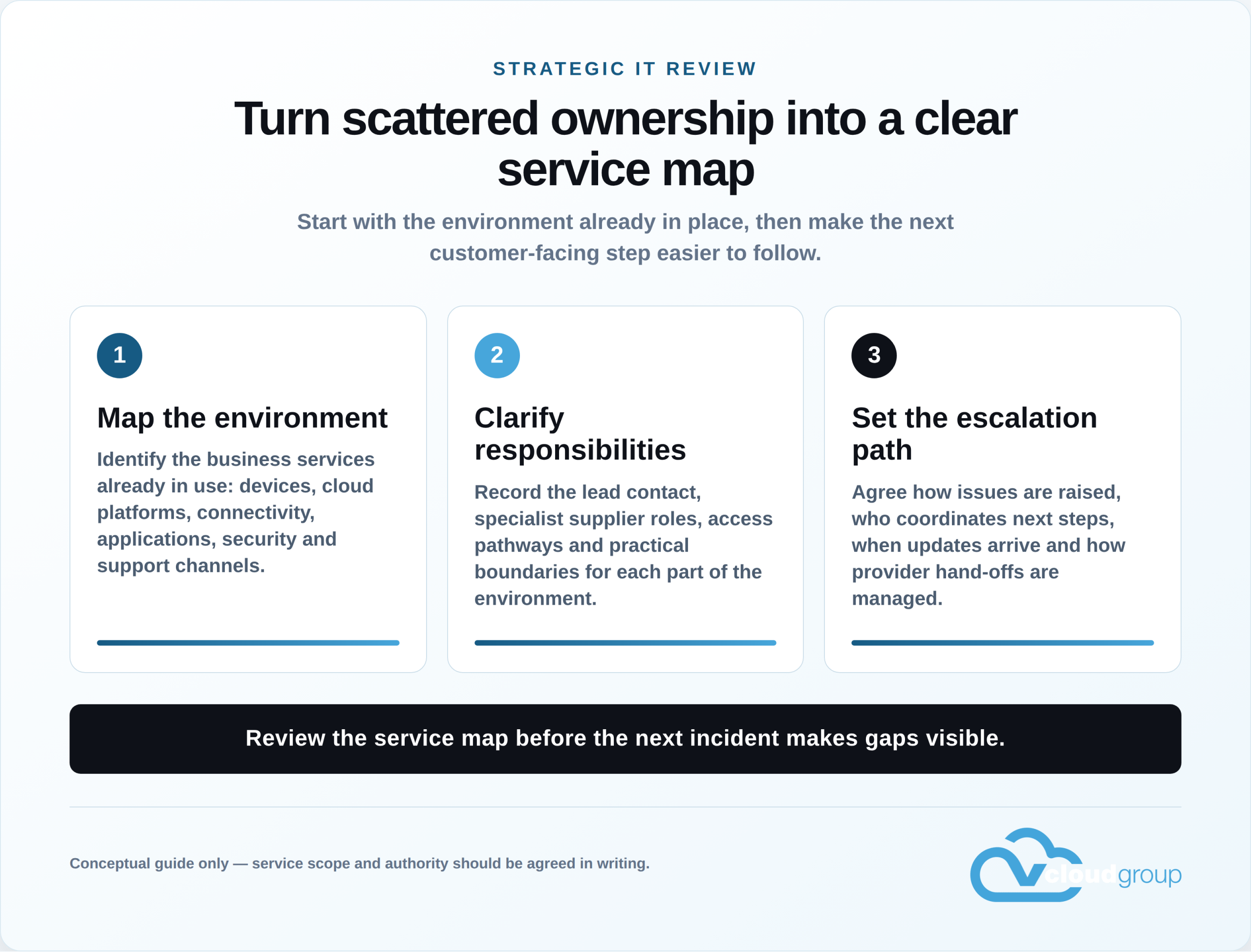
vCloud can also use regular service conversations to review recurring issues, planned changes and configuration responsibilities. This is not a substitute for the specialist vendor’s own obligations. It is a way to make sure changes are considered across the environment rather than in isolation. The detail should always be written into the service agreement, including exclusions, authority limits, response expectations and any third-party dependencies.
The broader vCloud Support managed IT support approach is built around giving businesses direct access to people who help resolve IT issues across the working environment. For small businesses, clarity about the first point of contact can be just as valuable as the technology itself.
A practical model for IT vendor management
Good IT vendor management does not require a business owner to become a technical project manager. It does require a simple, visible model that all relevant parties understand. The coordinating provider needs enough information and authority to recognise where an issue belongs, but the business should retain transparency over contracts, credentials, approvals and commercial decisions.
- Name the customer-facing owner. Decide who receives the initial request, opens or owns the incident record and provides updates when more than one provider is involved.
- Keep an accessible service map. Record the services, key contacts, renewal dates, dependencies and boundaries between cloud, connectivity, security, applications and devices.
- Set the hand-off rules before an outage. Agree what details move with a ticket, when a specialist is engaged, who has authority to approve changes and how the customer is updated.
- Keep one escalation path visible. The customer should not have to diagnose the technical cause before asking for help. The lead provider can coordinate triage, even when the eventual fix sits with another supplier.
- Review the arrangement. As technology, staff and suppliers change, revisit the responsibility matrix and make sure it still reflects how the business operates.
This model is especially useful for managed IT support for small business environments, where owners and office managers often carry several operational responsibilities. It does not remove the need for decisions, approvals or specialist involvement. It makes those moments clearer and reduces unnecessary relay work.
Questions to ask before you choose a lead provider
Whether you work with vCloud or another provider, ask practical questions. Who owns the ticket when the fault may involve more than one service? Which systems and third parties are within scope? Who maintains the configuration record? Can the provider contact other suppliers directly? Who approves changes? What happens when another supplier must act? How will the business receive status updates? The answers matter more than a broad “single point of contact” slogan.
Customers also need to decide what control they want to retain. Some will want direct supplier relationships and commercial approvals while delegating daily coordination. Others may prefer broader consolidation. Both can be valid. The important thing is that the service model matches the business, rather than leaving responsibility ambiguous until something fails.
For more practical technology guidance, the vCloud Group Knowledge Hub brings together articles across cloud infrastructure, cybersecurity and managed IT support. The same principle applies across those topics: the people responsible for the business should be able to understand who owns the next step.
Book a Strategic IT Review Session
If your business has several IT suppliers, we can help you map the current environment, identify responsibility gaps and discuss a practical accountability model. The review is a conversation about your existing setup and priorities—not a requirement to replace every provider.
Book a Strategic IT Review Session